Having multiple locations for your business can offer massive benefits, including the opportunity to serve customers in various areas, an increased number of customers (and higher revenue), and brand awareness, among other things. However, with countless competitors across the web, standing apart online and meeting regional searchers right where they’re at can be challenging to achieve. While multiple locations can yield enormous rewards, an innovative approach to digital marketing is required, especially when it comes to search engine optimization (SEO).
To find success online, you have to meet local customers through local search results, or else you have little to no chance of offering them your services or products. But, how do you effectively market your multi-location company on the internet and capture local searchers right where your business is located? The answer lies in local SEO strategies.
In this blog, we’ll explore local SEO for businesses with multiple locations. You’ll learn 5 practices to implement and 3 common pitfalls to avoid, resulting in a local SEO plan that leads to enhanced qualified leads and peak performance online.
What is Local SEO?
Local SEO is a set of organic practices that improve a brand’s visibility in local search results, which is especially crucial for multi-location businesses. By optimizing online presence for each location, companies can ensure that customers can quickly discover their services or products in specific geographic areas. For multi-location businesses, local SEO helps boost visibility for each location and establish a cohesive brand presence across all service areas, ensuring that potential customers find the correct information no matter where they search. In this blog, we’ll cover the 5 following local SEO strategies:
- Create and optimize pages for each location.
- Target geo-specific keywords.
- Build and optimize Google Business Profiles (GBPs) for each service area.
- Maintain consistency across all local citation listings.
- Emphasize high-quality link-building.
If you’re looking to strengthen your current local SEO strategy or need to start from scratch, here’s a step-by-step guide to helping your multi-location business grow online:
Local SEO Strategy for Multiple Locations: 6 Best Practices
1. Create and optimize pages for each location.
The first step in a local SEO strategy for multi-location companies is to create separate landing pages for each service area. State, county, and city location pages should include a few key elements:
A URL with the location name. URLs help both users and search engines understand the content of a webpage. Search engines (like Google) constantly crawl your website, ensuring URLs are relevant to what’s on the pages. URLs help online visitors properly navigate different pages, understand your site’s hierarchy, and find exactly what they want. If you own a counseling business with multiple locations in Kansas, your URL for the Wichita location page may be www.counselingbusiness.com/locations/wichita. This signals to users and search engines which location they’re learning about and boosts your local SEO strategy.
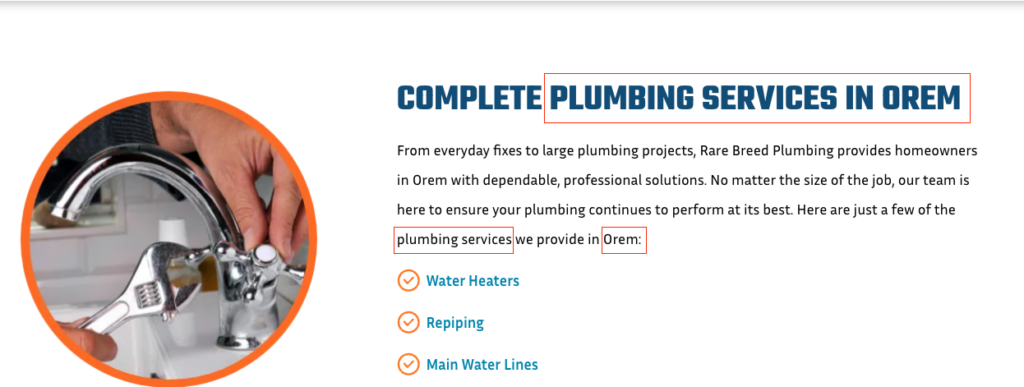
Include the city, county, or state name throughout the content. Ensure the service area’s name is listed in the page’s H1 header and some other supporting headers. Search engines read pages similar to how you’re reading this blog, first reading the headers and then ensuring the content supports those titles. Targeting the city, state, or county you serve on every location page increases your site’s relevancy in the eyes of search engines and helps users quickly navigate each page. Here’s an example of a plumbing company in Orem, Utah:
Geo-specific metadata. Metadata appears on the search results page, informing search engines and online visitors about your location page.
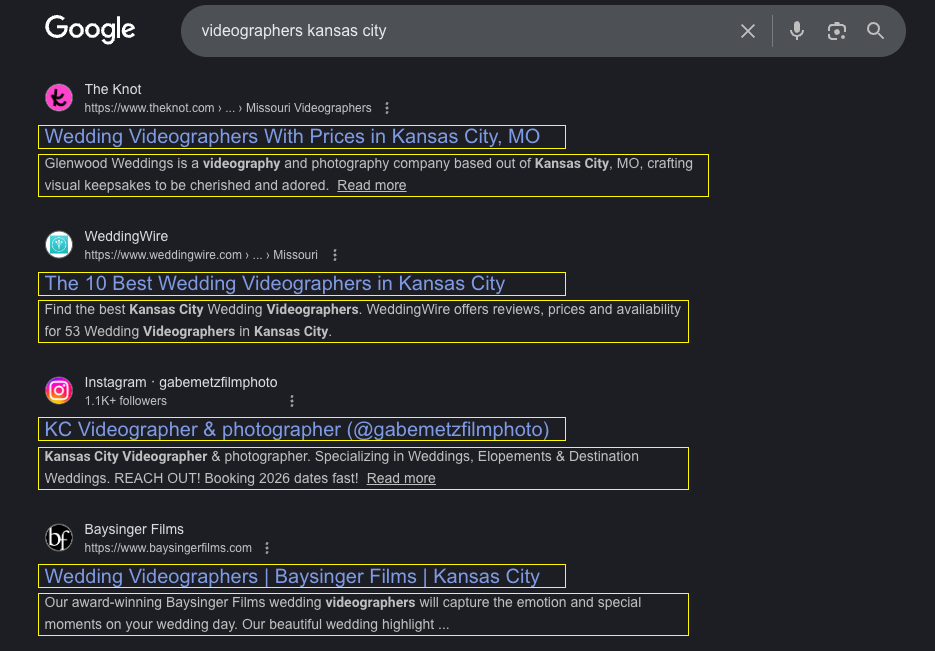
Include your location-specific keywords (more on that later) in the meta title and a call to action in the meta description. Keep meta titles to 60 characters or less and meta descriptions at a maximum of 160 characters.
If you own a multi-location general contracting business, your metadata could look something like this:
- Meta Title: General Contractor in Detroit | Dave’s Contracting
- Meta Description: Do you need a general contractor in Detroit? We’re dedicated to overseeing your construction project with attention to detail and a can-do attitude. Call now!
Link to your Google Business Profile and embed a map. We recommend embedding a Google Map connected to your Google Business Profile (GBP) on each location page. An embedded, interactive Google Map (rather than only displaying an address, city name, or static map image) saves users the steps of opening a new browser window, leaving your site, and finding directions to your office. Make it easier for them and increase the likelihood of Google associating your site with your GBP, helping your overall online presence.
Internal links to geographically nested sub-area pages. For example, a state page can link to its county pages, and county pages can link to individual city pages (e.g., Missouri → Greene County → Springfield). Including these links on each relevant location page improves user navigation and helps Google more easily crawl and understand your site’s hierarchy, which can support stronger indexing and site authority.
Contact information for each service area’s office. Include the address, phone number, and email address (if applicable) for the local office that serves the city, state, or county referenced on the page in question. Having consistent contact information on every location page helps visitors find and contact your business and ensures they know what types of services or products are offered in that location.
A section detailing the services or products you offer in that area. Implement a “Services/Products Offered” section on each location page. This helps users know what services or products are available in their nearby area. For example, if you own a cleaning company, you may mention commercial cleaning, vacation rental cleaning, residential cleaning, and other services you offer.
2. Target geo-specific keywords.
Optimizing your site and separate pages for geo-specific keywords is key to ranking for relevant search results on Google and other search engines. Assuming you’ve already brainstormed a list of keywords, you’ll need to localize those search phrases to ensure you’re attracting nearby customers instead of users who don’t live near your service area.
Here’s an example of a few localized keywords for multi-location businesses from various industries:
- Plumber — Plumber in Dallas, TX
- Car wash — Chicago car wash
- River rafting — River rafting Jackson Hole
You’ll also need to do additional keyword research using tools like Semrush or Ahrefs to identify further keyword opportunities and determine which localized phrases give you a greater chance of ranking on the search results page. Referring back to our example of “River rafting Jackson Hole,” if you owned a multi-location raft trip outfitter with locations across the US and want to focus on the office near the Tetons, you may want to target these additional search phrases throughout your site or on a dedicated location page.
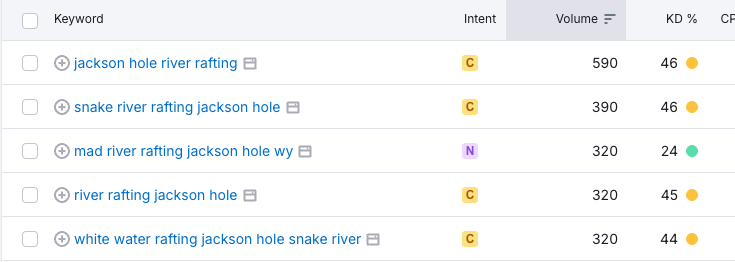
Once you’ve conducted keyword research for each service area, you’ll want to craft content that naturally targets these search phrases. As mentioned, this can mean naturally including keywords in the headers and throughout the body content of each location page and the site.
3. Optimize Google Business Profiles for each service location.
Did you know that 75% of top-ranking pages have complete Google Business Profile descriptions? If your multi-location business doesn’t have complete Google Business Profiles set up for each service area, you’re missing out on ranking in regional search results and a surplus of potential nearby qualified leads. Creating and optimizing GBPs for each of your office locations is a proven local SEO practice that boosts rankings in local search results and increases regional interest.
Before Your GBP Goes Live:
- When creating your GBPs, select all the relevant categories (there are over 4,000 to choose from and counting, so it may take some time) to help users easily find each of your business locations online.
- On your GBPs, add up-to-date hours and the consistent, accurate company name, service area address, and phone number (NAP).
- Write an engaging, keyword-friendly description of your business that clearly explains what you offer and where you operate. While Google Business Profile descriptions are not a direct ranking factor, including localized keywords helps reinforce relevance for users and provides context about your service areas. Add a call-to-action (CTA) at the end of your description to encourage users to engage with your business.
- Add high-resolution photos that represent your brand. GBPs with photos are twice as likely to appear reputable to online users. Include pictures of your office, services, or products in action, and satisfied customers.
Once Your GBPs are Complete and Active in the Digital World:
- Consistently publish updates through Google Business Profile Posts, such as new blog content, promotions, events, or special offers, to keep your profile fresh. Regularly posting updates (with photos) on your multiple Google Business Profiles increases brand awareness and authority and proves to Google and users that your business is active and engaged. Posting to your GBP is a great way to move your customers down the marketing funnel, starting with a snippet of a blog post and ending with a new customer at your door.
- Start earning reviews. Since 90% of searchers read reviews before purchasing a product or investing in a service, having numerous positive reviews on your GBP is essential. You can start receiving reviews by reaching out to past customers, sharing your review link in follow-up or email campaigns, and making it easy for customers to leave feedback. Building a reputable GBP hinges on positive customer feedback, so quickly establish a solid online rapport!
- Positively respond to all reviews, whether the feedback is favorable or not. Positive reviews can improve your local reputation for each service area, but responding to negative input shows that your company cares about client satisfaction and loyalty. Being a responsive business owner proves to potential customers that you’re active, engaged, and committed to the quality of your services or products.
4. Maintain consistency across local business citations.
Another crucial part of local SEO for multi-location businesses is maintaining accurate, consistent business information (company name, address, and phone number) across all regional business citations.
Google constantly looks at signals across the web to determine what information about your company is reliable and accurate. That means if your business details are listed inconsistently across location pages, local online citations, and review sites, then Google doesn’t trust that information and isn’t likely to showcase your business on a search results page. The more accurate your information is across all sites and pages on the web, the more you’ll build trust with Google that it’s correct, and they’ll reward you with a high ranking in the search results.
For businesses with multiple locations, it’s paramount to keep each office’s information accurate wherever it shows up. This includes, at the very least, your business name, address, and phone number. Google is meticulous—even a minor inconsistency can potentially be noticed, such as abbreviating a street name on one listing but not another. For instance, it’s best practice not to list 345 South Shore Dr. #2 on one business citation and 345 South Shore Drive, Suite 2 on the other, even if they direct the online user to the same address.
Multi-location businesses must ensure their company name is consistent across all listings, reinforcing to Google that these locations are part of the same business. The phone number and address will indicate they operate in different service areas.
5. Focus on high-quality link-building
Backlinks are links to your site from an external website. Acquiring links from other websites under a similar niche as your company’s is a longstanding local SEO practice for multi-location businesses. Backlinks prove to search engines that your site is authoritative and reliable, which leads to improved rankings.
Building backlinks, especially if they’re on local sites, can boost your regional SEO efforts dramatically. Here are 4 methods you can try to earn qualified local backlinks:
- Contact local bloggers or micro-influencers (that interact with your target market or niche) in your service area and ask if they’d be interested in sharing content from your site or allowing you to write a guest post on their website.
- Host local events, teams, or organizations to earn a link to your site and increase community awareness.
- Get local press coverage about your company’s multiple locations.
When earning backlinks, ensure you’re building them on niche-related sites that are authoritative and trusted in the community. Check out how many keywords the host site currently ranks for to ensure Google favors their website. When crafting your anchor text (the text that’s clickable when you add a link to it), ensure it is localized (e.g., “property management in Portland, Oregon”) so that search engines associate your site with that service area. We recommend linking to each of your location pages for increased online visibility. Quality over quantity is the golden rule with backlinks, so take your time finding qualified websites for your link-building efforts. For example, 100 links from the same referring domain are typically far less valuable than even a smaller number of links from unique referring domains.
3 Things to Avoid in Local SEO for Multi-Location Businesses
While you test out these local SEO strategies, here are 3 things you should look out for that could hurt your franchised company’s online presence:
- Keyword Stuffing
Refrain from stuffing your content with keywords when implementing these local SEO practices for your multi-location business. This makes your content feel unnatural to online users, and Google is smart enough to pick up on keyword-stuffed content, resulting in lower rankings and a damaged reputation.
Let’s say you’re creating a location page for a pet grooming business in Charlotte, North Carolina, and targeting the keyword “pet grooming Charlotte.” You start writing content that reads like this:
Our pet grooming company in Charlotte, North Carolina, is the best place to bring your furry friend for a self-care day. If you’re looking for a top-rated pet grooming team in Charlotte, look no further than Teddy’s Pet Grooming in Charlotte, North Carolina. High-quality pet grooming in Charlotte is hard to come by, so don’t miss this opportunity! Contact our professional pet grooming business in Charlotte, North Carolina, for 5-star services.
Did you notice how unnatural that sounds? Keyword stuffing is easy to spot and doesn’t look good to readers or search engines. When you include keywords in just about every other word in your content, you’re going against Google’s quality guidelines and putting your business at risk of losing out on high search result rankings and online exposure. A good rule of thumb we follow is to use primary keywords 1–3 times per 250 words, but this isn’t a strict rule. Focus on natural usage and relevance instead.
- Duplicate Content
When creating location pages, recycling your content and copying and pasting the same wording across every page is tempting. We’re not saying it’s easy to develop new content communicating similar ideas for different service areas, but duplicating content is a local SEO no-no. Search engines immediately detect (and often penalize) copied content across a site’s pages, hurting your site’s ranking ability since Google will only index the page it deems as the “original,” which actually defeats the purpose of building location pages.
Instead, create original, unique content for each location page. If relevant, include a few sentences about the city, state, or county, along with the services or products you offer in that service area. For example, suppose you own a property management company. In that case, it’s relevant to include information about regional rental prices, different landmarks that draw new renters to the area, and how viewers can benefit from property ownership in the city you’re writing about.
It’s okay to use similar language to share the same idea, but make sure there’s variety across every location page so that search engines see it’s not duplicated. We also recommend using different location-accurate photos for each service area to help differentiate the pages!
Creating separate state, county, and city pages for multi-location businesses can be time-consuming. If you’d like to focus on other aspects of your company, contact a marketing agency like Rock Salt Marketing for help in creating local SEO-focused content.
- Lack of Monitoring Results
Suppose you’re not monitoring and tracking the results of your local SEO efforts. In that case, you won’t have the insights needed to evaluate how well your strategies are working or to optimize them for better results. There are 3 components you should consider tracking:
- Keyword Rankings: Utilize tools like Google Search Console, Semrush, Ahrefs, or Moz to determine how your localized keywords perform. Most of these tools allow you to monitor search phrases’ performance in specific regions, which is especially important for multi-location businesses with various service areas.
- Organic Site Traffic: Track your organic site traffic to measure how much is coming from users within each service area. Google Analytics and Google Search Console are helpful tools for tracking site traffic by location.
- Conversions: The most critical measurement for a successful local SEO campaign is tracking the number of conversions your multi-location business generates. Conversions are any “key event” or form of engagement with your company, including phone calls, contact form submissions, emails, sales, and more. Tracking conversions, whether as service inquiries or phone calls, is crucial for optimizing your local SEO strategies and achieving better results. If you’re not meeting your online goals, revisit the above best practices and determine how to improve performance.
Improve Your Local SEO Efforts With Rock Salt’s Team
Local SEO for multiple business locations can be daunting, especially if you’re entirely new to optimizing your site for search results. Following these 5 best practices is a great starting point, but an effective and seamless local SEO strategy requires constant pivoting, monitoring, and improving your optimization techniques.
If you’d like professional expertise for your local SEO efforts, Rock Salt Marketing’s team is here to provide the online solutions you need to thrive. We specialize in local SEO services for businesses from various industries across the United States and Latin America. Contact us to achieve high-converting results from your multi-location business’s local SEO plan.