Consistency and strategy are crucial for an SEO strategy that delivers a high ROI. An SEO content calendar helps you stay organized, plan, and create content that drives lasting results. In this guide, I will walk through how to build a content calendar that sets you up for long-term SEO success.
What is an SEO Content Calendar?
A content calendar primarily aims to plan, organize, and optimize content to align with your SEO goals. A structured calendar will include the dates and locations where you’ll publish search-conscious content on your website, such as location pages, blog posts, articles, and other digital content.
Using a content calendar isn’t only for making the creation and publication process seamless; it also helps:
- Ensure your site is earning more rankings for relevant keywords. By using keyword mapping (more on that later), you can intentionally plan content that targets what your audience is already searching for.
- Increase domain authority. The more high-quality content you produce consistently, the more your site will be seen as authoritative and trustworthy in the eyes of Google. Other people on the web will also likely want to link to the content you’re posting, improving your site’s authority even more.
- Ensure consistency, which directly impacts your SEO results. SEO is a long game. In fact, one Ahrefs poll found that 58% of brands utilizing SEO strategies didn’t see results until 3–6 months in. Once the initial work (e.g., keyword research, keyword mapping, content ideation, etc.) of creating a content calendar is done, it becomes much easier to maintain long-term consistency, directly streamlining your SEO strategy.
- Track content performance: Organizing content in one place helps you see which topics and keywords drive the most engagement. Monitoring metrics such as rankings, clicks, and conversions enables you to refine your strategy based on real data. Over time, your content calendar becomes a tool for more intelligent, data-driven optimization.
Content calendars ensure that all your site’s content is organized in one place, preventing duplicate blog posts, missed deadlines, and confusion about what to write next. And a bonus? Having it all in one place allows you to revisit any decaying content that could benefit from re-optimization.
Tools You May Need To Create an SEO Content Calendar
There are various platforms available that enable you to create an SEO content calendar. Choose a tool that fits with your team’s workflow and budget.
Here are a few options to consider:
Google Sheets: Google Sheets is a free, cloud-based tool that lets you build a customizable content calendar for tracking ideas, deadlines, and publication dates in real-time.
Asana: Asana is a project management tool that helps teams plan, assign, and track content tasks within broader marketing campaigns.
Trello: Trello utilizes a simple Kanban-style board to organize content from ideas to publication, providing teams with a clear view of their workflow.
When determining which tool to use, test out different options to see what fits best for your team.
What Should a Content Calendar Include?
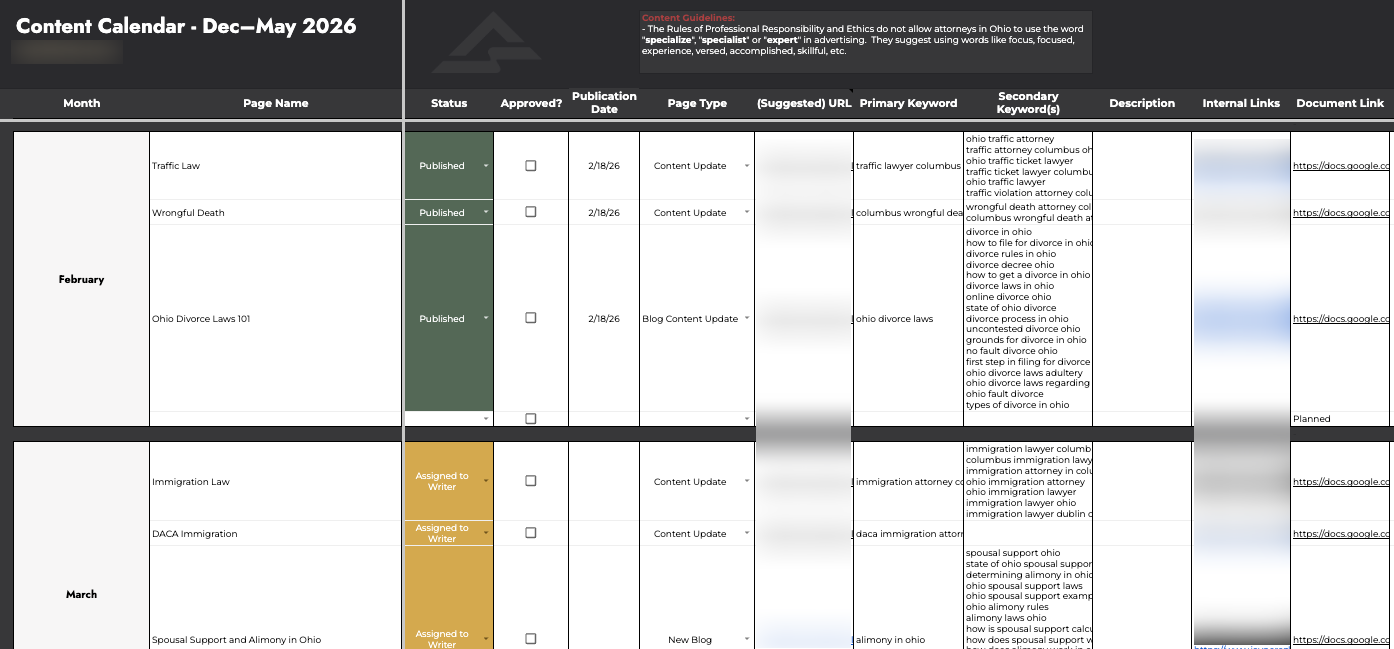
Several elements should be included in an SEO content calendar. Each team is unique, so select factors that align with your business objectives and optimize your workflow. Here’s what I like to include in an SEO content calendar:
- Content Title: The name of the page or post you’re creating. This could be a blog, service page, location page, or another key area of your website. Using words like “Guide,” “How-To,” “# Steps to ____,” or “For Beginners” in blog titles can be highly clickable to online users. In fact, blog posts with “Guide” in the title get three times more organic traffic than other articles.
- Content Guidelines: Outline any copy or brand guidelines your team (or content writers) should follow, which could include preferred ways to write your business name, phrases to use or avoid, tone and style notes, or restrictions such as “don’t make guarantees of X.”
- Status: Statuses could include planned, assigned to writer, in progress, revisions, sent for publication, published, and rejected.
- Publication Date: The date the content is published.
- Page Type: Identify the type of content being created or re-optimized, such as blogs, core pages (e.g., Home, About, Service, or Area Served pages), videos, infographics, or downloadable resources.
- Suggested URL Slug: If there isn’t an existing URL, update this once the new content is published. Be sure to include the target keyword in the URL—while it’s not a major ranking factor, it’s still considered an SEO best practice.
- Keywords: Identify one primary keyword to focus on for each page, often the term most relevant or searched for. Support it with 2–3 related secondary keywords to add context and depth. If additional keywords don’t fit naturally, plan separate pages to target them instead.
- Internal Links: Internal links are links from one page on your site to another, helping search engines crawl your site efficiently and boost your rankings. Use them to guide readers to key actions (like contacting you) or related content for deeper engagement.
- Content Outline: Each SEO content calendar entry should link to a detailed content outline. This can include key elements like target keywords, URL slug, meta title, and description, as well as any additional notes. Feel free to customize it to fit your preferred format or workflow.
- Extra Notes: This is optional, but can be used for any additional notes for yourself or your team.
For reference, here’s what my content calendar looks like. However, you can customize yours according to your goals and preferences.
How to Create an SEO Content Calendar: 6 Strategies to Keep in Mind
1. Keyword research informs the content plan.
One common mistake I see in content planning is skipping the research into what people are actually searching for when they’re trying to find your business. You may own an automotive business and plan content around your latest services or promotions, but your efforts may fall flat if no one is searching for those topics online.
Instead, ongoing keyword research ensures your content aligns with what potential customers are already searching for, positioning your business as the solution they need. To turn those insights into a strategic plan, you can follow three general steps when creating an SEO content calendar:
1. Conduct Keyword Research
A solid SEO strategy begins with keyword research, which involves identifying and analyzing the words and phrases that users actively search for to find your business online. By understanding what your target audience is already searching for, you can tailor your SEO content calendar to plan and publish content that meets their needs, answers their questions, and boosts your chances of ranking higher in search engine results. Keywords act as the bridge between what potential customers are searching for and the content your SEO calendar plans and produces to satisfy their needs.
If you’re new to keyword research, here are a few tips to discover search terms relevant to your business:
- Start by brainstorming a list of keyword ideas, based on what you think online users would be searching for to find your business. For instance, continuing with the automotive business idea, potential customers might ask about “how often to change your oil” or “why is my car pulling to one side.” These initial terms are called seed keywords, which you’ll plug into an SEO keyword research tool. Include local keywords in brainstorming, including the city, state, or county you serve, along with your services (e.g., “Boise lawn care services,” “family dentist Boise Idaho,” “Boise home cleaning”).
- Utilize tools such as Semrush, Moz, Ahrefs, and Google Keyword Planner to expand your keyword list. Enter seed keywords to find broad, related, and question-based variations that reveal how users search for your topic.
- Find keywords your website is already ranking for—these can help you brainstorm related keyword ideas, optimize existing pages, and take advantage of low-hanging fruit opportunities. Google Search Console and Semrush’s Domain Overview or Organic Research Tool are tools I like to use to analyze what keywords a site is already ranking for.
- Use tools like Semrush’s Keyword Gap, Ahrefs’ Content Gap, or Moz Keyword Explorer to find keywords your competitors rank for, but you don’t. These insights reveal content gaps and high-potential topics to target. Incorporate them into your SEO content calendar to stay ahead and capture untapped traffic.
These tips are only a starting point. To learn more, read my comprehensive guide on SEO keyword research.
2. Analyze Keywords
Once you’ve compiled a list of potential keywords through brainstorming, analyzing your existing rankings, and researching competitors, the next step is to narrow them down by evaluating a few key SEO metrics.
Keyword Difficulty (KD) measures how hard it is to rank in Google’s top 10 organic results for a specific search term. Most SEO tools provide a difficulty score on a scale of 1 to 100. Several elements impact how difficult or easy it is to rank for a term, including SERP features, content quality, backlink profile, domain authority, etc. The higher the score is out of 100, the more challenging it will be to earn a high ranking, and in turn, earn qualified traffic.
- As with any metric, don’t let KD be the only factor you focus on. High-KD terms can still build authority when targeted with quality, in-depth content. Over time, this approach can earn backlinks and improve rankings, even for competitive keywords.
Search Volume indicates the average monthly number of searches for a keyword. Because it’s calculated as an annual average, seasonal trends can skew the data, so always factor in seasonality during keyword analysis. It measures total search queries, not unique users, so repeated searches from the same person still contribute to the overall volume.
- Don’t skip low-volume, low-competition keywords—they’re often easier to rank for and attract highly targeted users. These long-tail keywords can enhance your authority and yield rapid SEO gains. Read about how to find and target low-hanging fruit keywords to learn more.
Search intent refers to the purpose behind a user’s search query. While not a traditional metric, it’s essential to understand when planning an SEO content calendar. Search intent informs you what content to create for your target keyword. There are 4 primary search intents:
- Informational: Users seek answers or how-to guides (e.g., “How to make a candle”).
- Navigational: Users look for a specific site or page (e.g., “Instagram login”).
- Commercial: Users compare options before making a purchase (e.g., “best meal delivery services”).
- Transactional: Users are ready to purchase (e.g., “buy men’s running shoes size 8”).
As you analyze keywords, think of them as puzzle pieces that fit together to form your SEO strategy. Don’t rely too heavily on one metric—look at the whole picture, from search intent to competition level. Target long-tail keywords for steady, sustainable growth, and organize your content around a primary keyword supported by a few strategic secondary ones. This approach helps your site grow authority naturally while staying aligned with your audience’s search habits.
3. Target Search Terms With Keyword Mapping
You can start keyword mapping once you’ve analyzed and prioritized your keywords. Keyword mapping is the process of assigning search terms to relevant pages on your SEO content calendar that will satisfy search intent. Keyword mapping organizes your site around targeted search terms, reducing overlap and improving structure. It also supports internal linking and ensures each page aligns with search intent, helping boost rankings, engagement, and conversions.
Before mapping keywords to content, however, you may have countless search terms that need to be grouped into topics—but where do you start?
This is where keyword clustering comes in. Keyword clustering involves grouping related keywords that share the same search intent, which can help prevent overlap, support content depth, and inform internal linking strategies.
For instance, users searching for “queen size mattress,” “queen mattress,” and other variations want to purchase the same product, and Google displays similar pages in the results for each query. These keywords and their variations can be grouped for a single, comprehensive page that targets that topic. Having 2–5 keywords targeted on a single page (with one primary keyword) can increase the total number of keywords your content ranks for.
Similarly, keyword clustering can inform your blog strategy and SEO content calendar. You can plan a main, in-depth post around a core topic (sometimes referred to as a “pillar post”) and then schedule related, smaller posts that delve deeper into subtopics.
Keyword clustering also strengthens service and location pages by grouping similar search variations and aligning them under one optimized page. For example, if you offer plumbing services, you might cluster terms like “Salt Lake City plumber” and “emergency plumbing services” together for one page. This helps you cover all relevant variations while keeping your site structure clean and intentional.
2. Pay attention to the seasonality of topics.
SEO content calendars need to account for seasonality. Failing to do so can result in missed opportunities during the seasonal selling period, such as capitalizing on increased search volume, boosting conversion rates, and enhancing visibility for seasonal promotions, among other factors. Seasonal SEO, in the context of a content calendar, means aligning your content with the natural ebbs and flows of your ideal customers’ interests throughout the year. Identifying and targeting seasonal search terms or topics can result in increased ROI and increase your chances of meeting your perfect customers online before the competition does.
You can use several tools to understand the seasonality of topics. Here are 2 free tools you can start with:
Google Trends
Google Trends is a free tool you can use to track how search interest fluctuates with keywords relevant to your business.
Here’s how to use Google Trends to optimize for seasonality in your content calendar:
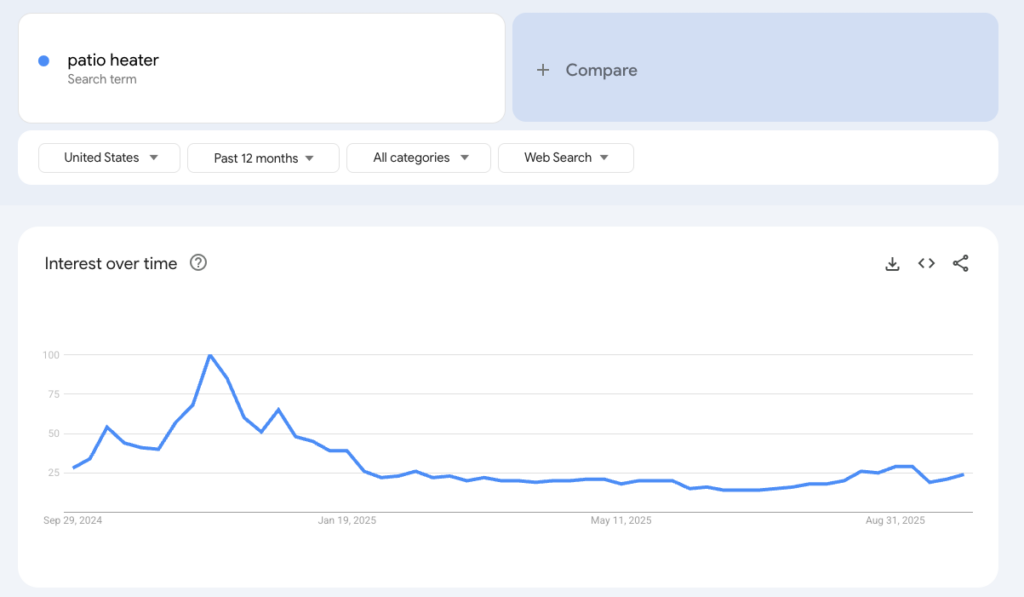
- Type in a relevant search term like “patio heater” to see how interest changes throughout the year.
- Compare related search terms to determine which has a steeper spike in the peak period. For example, “outdoor heater” or “backyard heater.”
- Localize your search terms to observe if the search term spikes in specific regional areas. In California, the term “patio heater” exhibits the same seasonal spike, reaching its peak at the end of November. That’s the perfect window to schedule content, like a blog called “Why Patio Heaters Are Essential for Your California Home,” on your SEO calendar to target your California audience.
- Review related search queries and incorporate them into your SEO content calendar to optimize your content. For instance, searches for “outdoor space heater” or “heat lamp” tend to rise around the same time as “patio heater,” which makes them smart keywords to target during the season.
Google Search Console
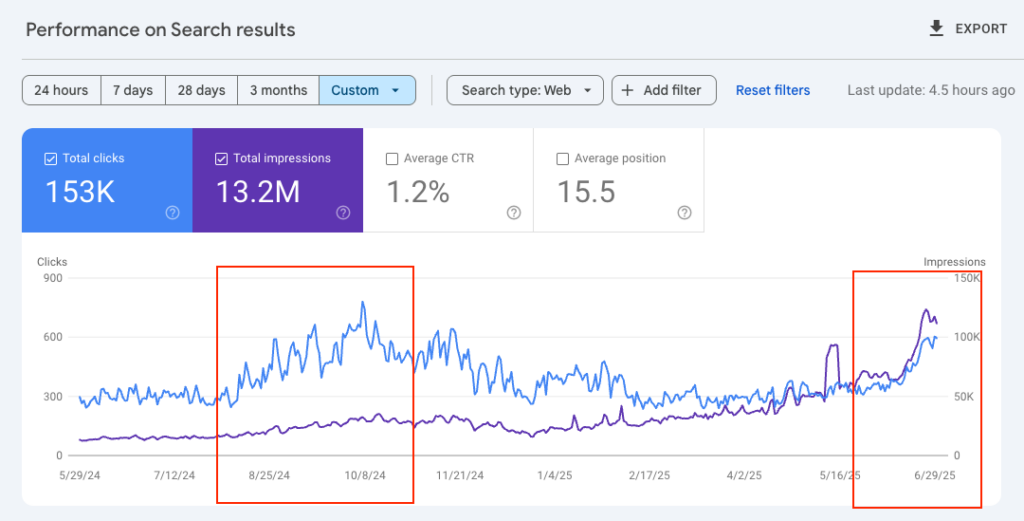
With Google Search Console, you can spot seasonal fluctuations in how often people search for and click on terms that lead to your website:
Seasonal trends show up as consistent peaks and dips around the same time each year. For example, this pest control company experiences peaks in the summer months due to higher pest activity. In contrast, traffic and search interest drop during the fall and winter, revealing opportunities to schedule educational or evergreen content during slower seasons and to ramp up promotional campaigns ahead of peak demand.
Open the “performance” tab on your Google Search Console to study how your website appears on search results.
Set the date range to at least one year, and use the “pages” and “queries” tabs to see what search terms and pages are trending throughout the year.
Analyze the impressions, clicks, and click-through rate (CTR) in the date range to look for fluctuations, peak times for search terms, and opportunities for seasonal SEO.
How to Optimize Your Content for Seasonal Trends
After understanding how user search intent changes throughout the year, you can optimize your content to account for seasonal fluctuations.
Here are a few ways you can optimize your SEO content calendar to make the most of seasonal trends:
- Using the keyword tools mentioned above, identify search terms that peak during specific times of the year and plan content around them. Examples include phrases like “spring cleaning tips,” “holiday gift ideas,” “winter pest control,” or “Mother’s Day brunch.” Add these topics to your SEO content calendar in advance so your posts are published right as search demand begins to rise.
- Review and update existing content to align with seasonal trends by incorporating relevant keywords and phrases that reflect seasonal fluctuations. For example, a blog about places to visit in Leavenworth, WA, could be optimized for “Christmas activities in Leavenworth” during the holiday season.
- Plan content ahead of the seasons. Search interest often rises weeks (or even months) before an actual event or season. Prepare for that spike by scheduling posts on your content calendar early so they have time to rank before peak traffic hits.
- Repurpose high-performing seasonal content. If a piece performs well one year, update and re-promote it the next with refreshed visuals, keywords, or insights—this saves time and maintains SEO momentum.
By utilizing your SEO content calendar to plan around seasonal trends, you can publish timely and relevant content that consistently attracts traffic and keeps your site top of mind throughout the year.
3. Include suggested internal links in your SEO content calendar.
Another crucial step in building an effective SEO content calendar is to think deliberately about internal linking. Internal links enhance site discoverability by facilitating search engines’ ability to crawl and index your pages. They also improve user experience by increasing click-through rates, establishing topical authority, and directing visitors to relevant content.
Suggest internal links in your content calendar that are relevant to each page. One way to plan for internal linking is to practice the pillar-cluster model.
Pillar-Cluster Model
Content clusters, also known as the pillar-cluster model, are essential for both SEO and content organization. Put simply, a content cluster is a collection of posts or pages built around one central topic that’s highly relevant to your business.
The pillar-cluster model often includes a cornerstone page, which is the most comprehensive piece of content regarding a broad topic on your site. Cluster content consists of related articles that link to the pillar—they often cover subtopics in greater detail. For instance, a pillar page on social media marketing could be supported by clusters including: “The Role of Paid Ads in Social Media Marketing,” “How to Measure Social Media ROI and Analytics,” “Social Media Marketing for Small Businesses,” and “How Social Media and SEO Work Together.”
When planning your SEO content calendar, think of your pillar pages as anchor points and your cluster content as supporting pieces that you can schedule around them. By intentionally mapping out these connections ahead of time, you ensure that every new article contributes to a larger content ecosystem rather than existing in isolation.
The pillar-cluster model not only strengthens your site’s SEO but also makes your calendar more strategic, helping you see at a glance where new content fills gaps, where existing posts can be repurposed, and how different pieces of content guide readers deeper into your site.
4. Stick to deadlines.
Content calendars serve as a project management tool for your SEO strategy, helping you and your team stay organized and on top of content creation. After assigning each piece to a writer, include clear deadlines on your SEO content calendar to ensure everything stays on track and is published on time.
Track the progress of each piece by using status labels such as “Assigned to Writer,” “In Progress,” “In Review,” “Revisions Needed,” or “Published.” This makes it easy to see where each article stands in the workflow, identify bottlenecks, and maintain a consistent publishing schedule that supports your SEO goals.
5. Write high-quality content.
An SEO content calendar is only the start of a high-converting digital marketing strategy. The quality of your content plays a crucial role in determining your search engine ranking. Your content plan may include blogs, location pages, service or product pages, how-to guides, infographics, case studies, and more—and every page must be written with the reader and search engines in mind. Don’t make the mistake of writing only for search engines or only for people. Great SEO content speaks to both.
When writing content, consider your audience’s search intent and thoroughly address their needs, answering their questions throughout the piece. Make your content readable and engaging. Keeping your content easily digestible can reduce bounce rate and increase time on page—two behavioral signals that suggest to Google your content is valuable and relevant. This can help boost your site’s authority and rankings over time. Use subheadings, short paragraphs, bulleted and numbered lists, and simple, clear language. Images, videos, graphics, or other visual elements can boost your content and make it more engaging for your audience.
When writing content, here are a few common pitfalls you’ll want to avoid:
- Keyword Stuffing: Don’t overload your content with keywords. This can lead to penalties from search engines and isn’t a great experience for online users. Focus on creating quality, original content that genuinely helps your audience.
- Copycat Content: Duplicate or overly general content can harm your search engine rankings and weaken your authority in your industry. Instead, focus on creating content that offers a unique perspective and demonstrates subject-matter expertise.
6. Track content performance and optimize as needed.
Once your content calendar is up and running, the next step is to make sure your strategy is actually paying off. Tracking key SEO metrics, such as keyword rankings, impressions, and clicks, allows you to evaluate your content’s performance and pinpoint areas for improvement.
Keyword Rankings measure your page’s position in the SERP for specific keywords. This metric can help you determine the effectiveness of your SEO content strategy in targeting particular terms. Several online platforms offer keyword ranking tracking, including Semrush’s Position Tracking Tool, Ahrefs’ Rank Tracker (or their free Keyword Rank Checker), Ranktracker, and Keyword.com. Many of these tools enable you to monitor keyword positions and track changes over time, allowing you to compare your SEO efforts against those of your competitors and identify optimization opportunities.
- Insider Tip: SEO isn’t a one-time task—it’s an ongoing process. Continue doing keyword research regularly to find emerging search trends and content gaps in your niche. As you discover new opportunities, schedule fresh, optimized content on your SEO calendar that aligns with those keywords. Consistent publishing and optimization help maintain (and improve) your visibility in search results.
Impressions & Clicks indicate how often your content appears in search results and how many users are engaging with it by clicking on the page. This metric helps you measure your content’s online visibility and reach, allowing you to identify underperforming pages that may need optimization to improve performance. Find your Google Search impressions and clicks in Google Search Console by clicking “Search results” under the “Performance” tab. Here, you can view impressions and clicks by query, page, country, device, search appearance, and date. Use this data to spot underperforming pages that could benefit from updated keywords, new visuals, stronger meta descriptions, or refreshed content.
Utilize these metrics to gauge how your SEO-friendly content is performing, and keep your strategy dynamic by consistently researching keywords, creating new content, and optimizing existing pages.
Plan for Success With an SEO Content Calendar
Creating an SEO content calendar isn’t just about organization—it’s about strategy. When you plan your content with keywords, seasonal trends, internal links, and search intent in mind, you position your brand for sustainable growth and consistent online visibility.
However, planning an effective content calendar can be an overwhelming task, especially while you’re trying to run a business. At Rock Salt Marketing, we specialize in SEO strategies that free up your time as a business owner, resulting in high rankings, increased conversions, and a steady influx of leads. We create content calendars for our clients that are informed by in-depth keyword and competitor research, seasonal trends, and their unique goals.
If you want to reap the benefits of an SEO content calendar without putting the time into making one, we’re the team for the job. Contact our Salt Lake City and Nashville SEO professionals to get a strategically developed content calendar designed to drive your online success.