Are you in the home services industry and struggling to stand out online? This is a common problem due to the immense amount of competition in the digital world. Fortunately, search engine optimization (SEO) can help solve this problem and help you build the online discoverability you need.
SEO is the process of optimizing your website for search engines, helping it rank higher in search engine results, and making it easier for potential customers to find you. For home service businesses, mastering SEO can significantly boost visibility, drive more leads, and grow your company. This guide will walk you through everything you need to know about SEO for home service businesses—from local SEO to earning backlinks—to improve your online presence and stand out in your regional market. Let’s get started!
3 SEO Practices for Home Service Businesses
Here are 3 basic SEO practices to help your home service business stand out online:
1- Local SEO
Local SEO is critical for home service businesses, especially those that service multiple areas. Like other components of search engine optimization, local SEO is a set of organic practices that increase a company’s visibility in regional search results. Following a set of strategies to optimize your business’s location(s), local SEO increases your chance of being noticed and easily found by your target market in a specific area.
Here are 4 basic local SEO practices to implement for your home service business, whether it’s a franchise or a single shop:
- Create location pages for each service area, targeting geo-specific keywords throughout the content.
One of the best things you can do for local SEO is to create location pages for each service area. Whether it’s a state, county, or city location page, we recommend including these elements:
Location-specific keywords: 46% of Google searches have a local intent, meaning most online users can’t find your home service business unless your site contains geo-specific search terms they’re using to find your products or services. When conducting keyword research, analyze localized phrases relevant to your business. Let’s say you own a property management company in Lansing, Michigan. On location pages, each page should be optimized around location-specific keywords. For example, targeting “property management Lansing” on a Lansing page and “property management Ingham County” on an Ingham County page, assuming these keywords have a high search volume. Integrate geo-specific keywords on every location page in a natural way to make you easily discoverable to local searchers online. Include these search terms in the page’s meta title and description to increase your local search engine rankings and online visibility.
Embed a Google Map & a link to your Google Business Profile: Embedding a Google Business map, instead of inserting a third-party map with your address, can save online viewers the time and effort it takes to leave your site, open a separate browsing window, and find directions to your office location. It’s also important to note that most online users may not need directions to home service businesses’ office locations. Nevertheless, it’s still beneficial to show your location to build trust, offer the option to visit if required, and signal to search engines that you serve specific geographical areas, improving your online presence long term. It’s also believed by many SEO experts to help Google associate your Google Business Profile with the specific location page in question.
Name, address, and phone number for the service area’s office: On each location page, include the contact information of the office that serves the city, county, or state being referenced. A section outlining your business’s name, address, and phone number makes it simple for users to find and contact you for the services or products you offer in that area.
A section about services or products offered in the area: Include a section that explains the services or products offered on every location page, ensuring online viewers know exactly what you provide in their nearby area. For example, if you’re a plumber, you can mention services like tub and shower repair, residential and commercial plumbing, repiping, and more.
- Build and optimize your Google Business Profile(s).
Having a Google Business Profile (GBP) set up and optimized for your home service business is a crucial local SEO practice for online success, particularly for franchised companies. According to SOCi, in the U.S., there are more than 5.9 million keywords related to “near me” and 800 million searches per month that contain some variation of “near me.” If you want to be near the top of search results for that phrase, it’s vital to have an optimized Google Business Profile for your home service business’s location(s).
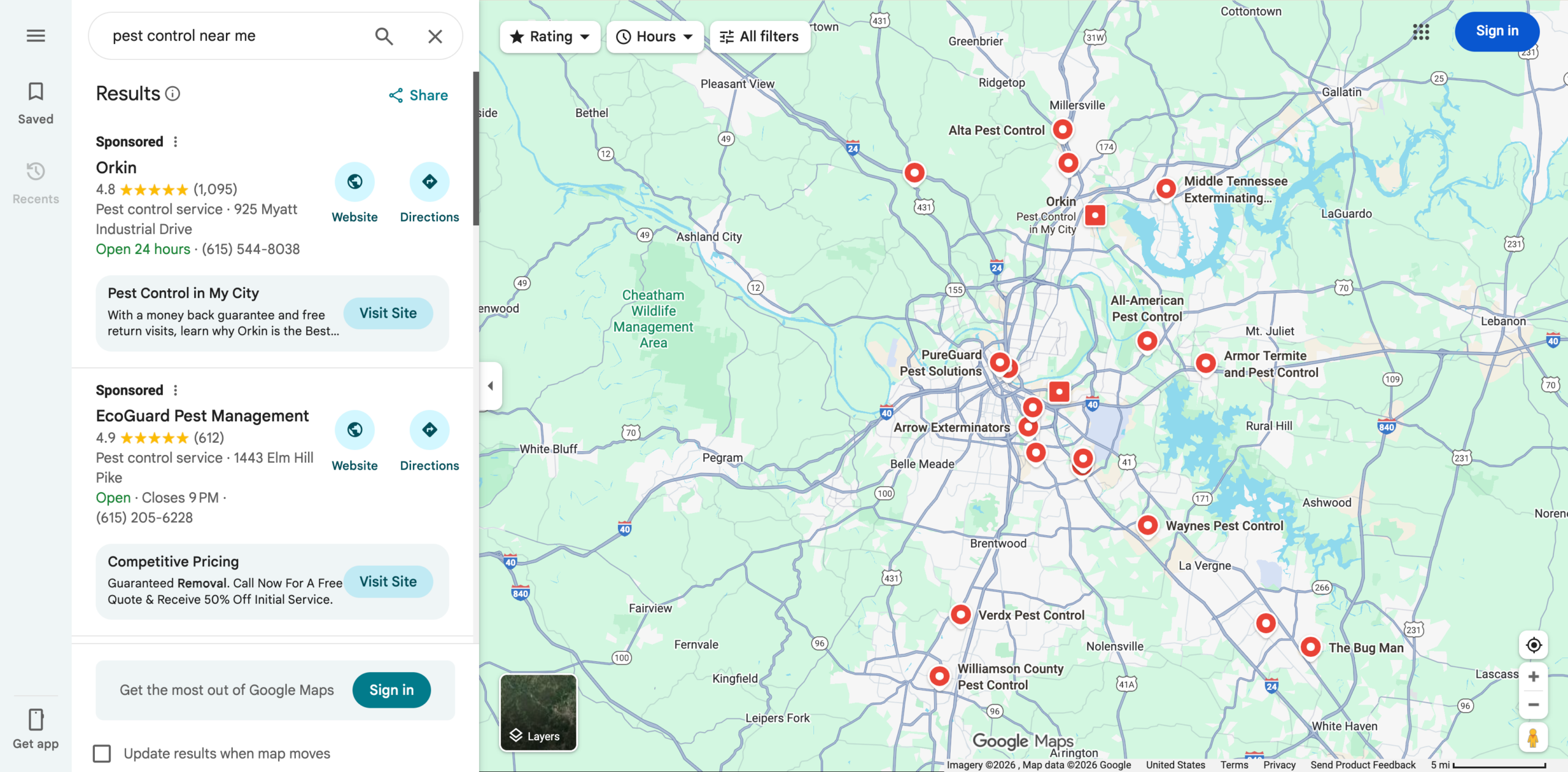
Here’s how you can make your GBP easily discoverable, ranking at the top of local search results and attracting regional attention:
- Complete every section of your GBP(s) with accurate, consistent information. Completed listings are 7x more likely to earn clicks than those left unfinished. Where is your office located? What’s your complete, up-to-date address? What categories are relevant to your company? Are there high-quality photos you can add to visualize your services? These are key elements that search engines and online users consider when determining how to consider your profile and whether they can trust your business.
- Write an SEO-focused description of your home services. An engaging description with geo-specific search terms in your GBP’s description doesn’t directly impact ranking, but it certainly helps boost engagement rates for your business’s service area(s). For example, if you own an eco-friendly cleaning company, your GBP’s description could say, “At [Company Name], we’re dedicated to providing top-rated, eco-friendly home and commercial cleaning services for Boston residents. We ensure your property is spotless by the time we leave. Call now to schedule our cleaning services in Boston and surrounding areas!” End your description with a call to action (CTA) to encourage viewers to engage with your business by calling or filling out a contact form.
- Consistently post on your GBP(s). Whether highlighting a snippet of a recent blog, a testimonial, or a current promotion, posting on your GBP(s) improves brand awareness and signals that your company is active and engaged with potential customers. For home service businesses, regularly updating your GBP(s) with photos helps showcase the effectiveness of your services, encouraging users to choose you for their next home project.
- Earn reviews and promptly respond to them, whether positive or negative. Send satisfied customers a link to review your business, include it in email campaigns, generate a QR code to place on your business cards, or offer non-contingent incentives (such as entry into a giveaway) that are not tied to leaving a positive review. Any incentives should be offered for honest feedback only and must comply with Google’s review policies for your GBP(s). 90% of online users analyze reviews before investing in a service, so having several reviews posted on your profile(s) helps local searchers know you’re trustworthy and attentive. Respond to all reviews on your GBP, even if they’re negative. If potential customers see your response to negative and positive reviews, it builds rapport and shows your dedication to quality and client satisfaction.
- Target regionally-focused keywords on your site.
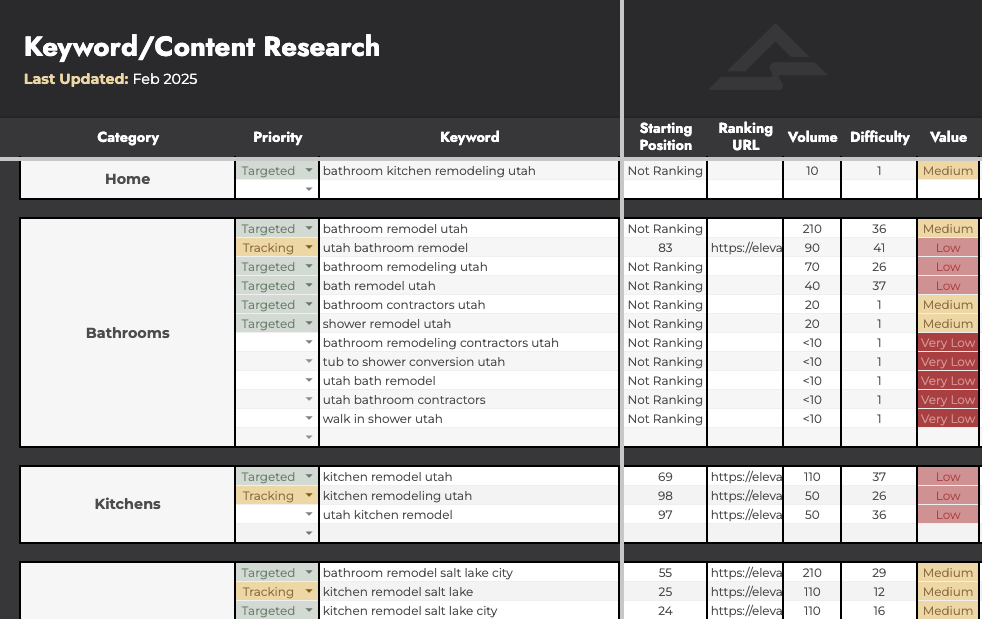
As mentioned above, thoughtful keyword research is essential for a successful SEO campaign, especially for finding location-specific search terms. Start by brainstorming keywords relevant to your business that searchers use to find your site. Then, use tools like Semrush or Ahrefs to expand your research and determine if the localized version of these keywords has desirable search volume (how many times a keyword is searched for in a search engine over a set period) and low to moderate keyword difficulty (how easy or difficult it is to rank for the search term). Additionally, consider search intent (whether the keyword aligns with what your audience is looking for).
Typically, you’ll want to target geo-specific keywords on your site’s location pages and other core pages (home, services offered). Here are a few examples of localized search terms for various types of home service businesses:
- Landscaper – Landscaper in Reno, NV
- Carpet cleaner – Carpet cleaning Washington DC
- Moving service – Moving service Philadelphia
There may be localized keywords with an informational intent (the viewer wants to know more about something, but perhaps isn’t looking to hire services or purchase a product) that can be addressed with blog posts. For example, a property management company located in California could target the search phrase “investing in real estate in California” in a blog post outlining the best cities to buy real estate in California:
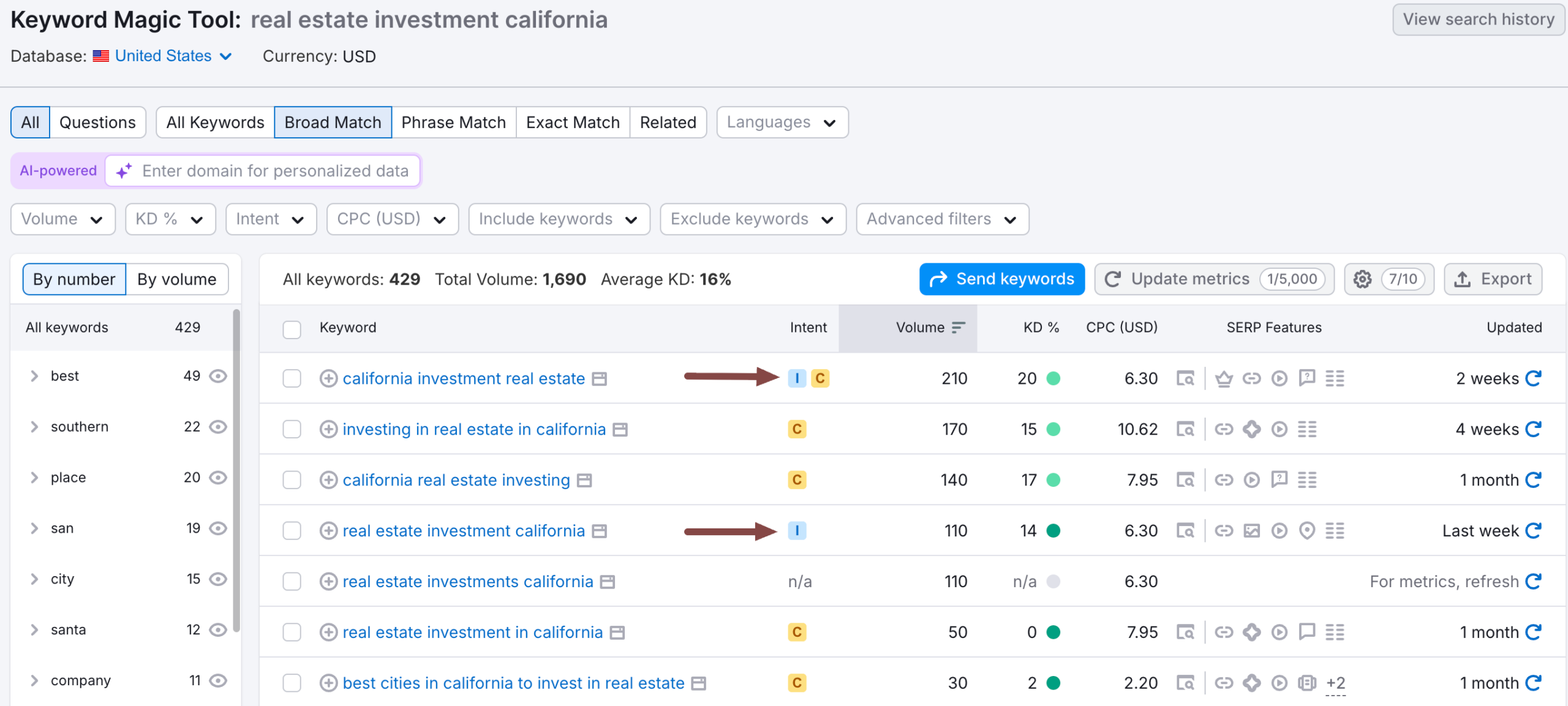
While targeting localized keywords within blogs is less common, it’s worth considering if the relevant geo-specific search terms are attainable and attracting attention from regional online users. Since readers of these blogs are more likely to be in your service area, there’s a potentially higher chance of conversion compared to articles answering general questions about home services.
- Ensure consistency across local business citations.
Another essential local SEO practice for home service businesses is maintaining accurate, up-to-date contact information (name, address, and phone number or NAP) across every business citation. Why is this important? Search engines consistently crawl the internet, ensuring your business’s information is reliable and correct. Suppose your company’s details aren’t listed consistently across location pages, online citations, and other review sites. In that case, search engines will decide they can’t trust that information, and your rankings on search results pages will suffer. However, if your business’s details are accurate and consistent, you’ll be rewarded by search engines with higher rankings and an increase in online traffic from local searchers.
Sources like BrightLocal, Moz, and Semrush have tools that can help you monitor your business citations, ensuring consistency and up-to-date information online. Google places a strong emphasis on citation consistency, making it a best practice for local SEO. Although small inconsistencies like street name abbreviations don’t always affect rankings, maintaining uniform business information helps reduce the risk of confusion for search engines and supports long-term discoverability. For example, it’s best not to list 782 North Hawk Court on one citation and 782 N Hawk Ct on another, even if both lead to the same location.
If you own a franchised home service business, ensure your company name is consistent across all listings. This helps Google recognize that your locations are part of the same business. Variations in phone numbers and addresses will signal that your company serves various areas.
2- Regularly Create Optimized Content
The phrase “content is king” is often used within content marketing and SEO—and for good reason. While this idea applies first and foremost to core pages like service and location pages, informational content such as blogs still plays a valuable supporting role. These pieces are secondary to core pages, but they help expand a site’s topical authority, attract users earlier in the buying journey, and reinforce overall SEO performance. For home service businesses, providing relevant, informational content can deliver meaningful online results—here are some stats to prove it:
- Websites with active blogs have 434% more indexed pages (explain it here) and 97% more inbound links (explain it here) than those that don’t.
- Companies that blog get 55% more site visitors than businesses that don’t.
- 70% of peopleprefer to hear about a company through blogs rather than advertisements.
Needless to say, blogging is a beneficial part of SEO for home service businesses—but it has to be properly optimized for search engines. Many home service businesses make the mistake of writing blogs based on what they assume potential customers want to hear rather than conducting extensive keyword research to understand what searchers are actually asking.
Before scheduling blog posts, start by brainstorming a list of topics and seed keywords with informational intent that your target audience might be searching for. Then, verify and refine that list using keyword research to confirm search demand, intent, and the best phrasing before you finalize your content plan. Below are just a few examples of keyword-targeted blog posts you could try:
- Answer common “how to” questions from customers, like “how to check ac compressor” or “how to get rid of earwigs.”
- Share tips related to your home service business, such as “bathroom remodel tips” or helping users solve a specific problem like “green pool water fix.”
- Check what search terms your site is already ranking for in Semrush to determine which topics are trending and which keywords (with an informational intent) you can target in blogs.
When conducting keyword research, focus on long-tail keywords (specific phrases with three or more words) to drive qualified traffic. Similar to localized search terms, target keywords with favorable search volume but low to moderate keyword difficulty for attainable SEO results. After you’ve decided which keywords to target, create optimized content around each search term.
Write search-conscious blogs by naturally including the primary keyword in the meta title and description, headers (H1, H2, H3), image alt text, and throughout the body copy. Avoid keyword stuffing and regularly produce high-quality content that’s insightful, helpful, and easy for readers to digest. Incorporating internal links to relevant pages or other blogs also improves your SEO efforts and ensures readers navigate through your site. Make sure blog posts provide in-depth information that adequately addresses the searchers’ queries. Consider including FAQs, step-by-step instructions, and images or videos to enhance the viewer’s engagement with your blogs.
3- Prioritize Link-building
High-quality blog content naturally supports link-building efforts, making it a key part of any SEO strategy for home service businesses. The last SEO technique we’ll review for home service businesses is link-building. Generating backlinks (links from other sites that link to your website) increases your chances of being recognized as an authoritative and reliable business in the home services industry.
The best way to earn backlinks is by publishing informative content that is naturally referenced by other websites, as it provides useful and trustworthy information that their audiences benefit from. Additionally, you can conduct outreach campaigns to ask for backlinks from niche-related sites or request to publish guest posts on other sites with links to your website. Build backlinks on reputable and legitimate sites within the home services industry. Pay attention to how many keywords the hosting site ranks for, revealing how much favor they’ve earned with Google. Prioritize quality over quantity in your backlinking efforts. Search engines prefer content that thoroughly answers searchers’ questions, so focus on building links within such content to experience success.
A Bonus Tip: Track Performance & Leads
While implementing these SEO techniques, don’t neglect performance tracking and lead monitoring. This helps you understand which keywords attract online visitors and yield qualified leads. Home service business owners can use tools like Google Analytics, Google Search Console, and CallRail to track leads. While Google Analytics monitors your site’s traffic and key events (e.g., call clicks, form submissions, downloads), Google Search Console provides similar insights and highlights valuable key terms, and CallRail tracks data from phone calls and contact forms, tracing them back to specific sources. Tracking your site’s performance helps you pivot your SEO strategy, ensuring you’re consistently earning more online traffic and climbing the online search ranks.
Hire Rock Salt For Your Home Service Business’s SEO Plan
Do you want to reach peak performance online but don’t have the time or knowledge to implement SEO strategies for your home service company? Rock Salt’s search engine optimization experts are eager to help you. We provide comprehensive SEO services for the home service industry, including keyword research, content planning and optimization, optimized site structuring, local SEO tactics, AI SEO, link-building efforts, and more. Reach out to our team to boost your online presence and generate qualified leads with a proven SEO plan.