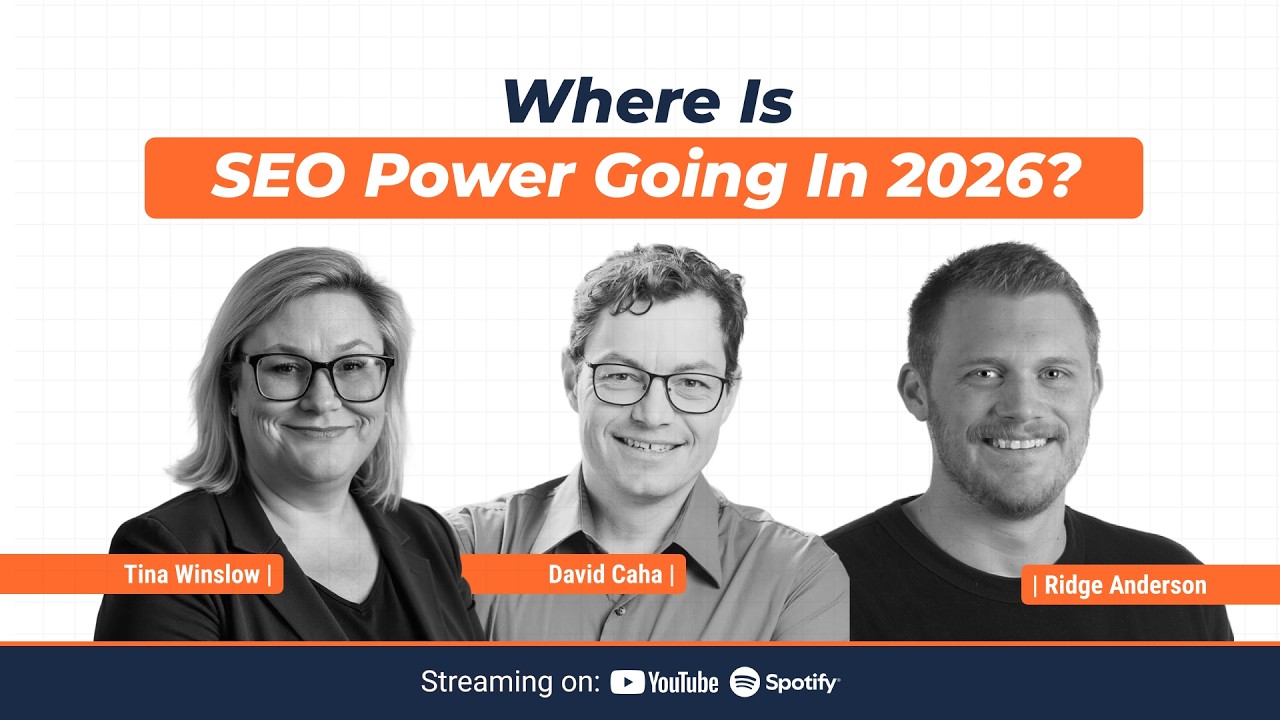
Ridge recently had the chance to join Koa Kauwe on the SEO On Air podcast for a roundtable with two other agency owners: David of Lutyca, a neuroscientist running a data-driven firm serving regulated industries, and Tina Winslow of Art of Strategy Consulting, who has been building digital trust and authority for clients since 1999. The three of them come at marketing from different backgrounds, but they landed in the same place on most of the big questions.
The conversation centers on the elephant in the room: AI has taken clicks and power away from traditional SEO, and that has forced all of us to recalibrate. Ridge’s take is that this shift has actually been an equalizer. Large language models reward strong brands, not gamed systems, which means content marketing, design, brand mentions, and genuinely useful content matter more than ever. If a tactic feels like gaming the system, it was never a lasting strategy.
They also get practical. They compare notes on measurement, including GA4, call tracking, qualifying leads rather than celebrating raw traffic, and why tracking AI visibility by topic has replaced the old keyword-equals-search-volume model. And we talk honestly about who should invest in AI SEO right now. Short version: if you don’t have a strong traditional SEO foundation, start there, because 80% to 85% of that work carries over to AI visibility.
We close on where agencies go from here. Ridge’s answer is the approach we’ve taken at Rock Salt: embrace AI to automate the busy work so our team can spend more time on strategy, analysis, and the human conversations that actually move a business forward.
The full episode is below, along with the complete transcription if you’d rather read than watch.
Koa
Welcome to SEO on air. I’m your host Koa Kauwe and this is brought to you by Stan Ventures. Today we have three guests with us that are going to give us their perspectives on how the marketing world has changed over the last couple of years. And honestly, give us their unique views on a few different things. I think AI was one of the things we wanted to talk about today and how we optimize that. But we’ll dive into those things after we get a chance to meet them. So starting with David, David, please tell us a little bit about yourself and your agency.
David
Yeah, thanks for that, Koa. So, yeah, I’m Dave. I’m a neuroscientist, and I run Lutyca. We’re a data-driven marketing firm focusing on anything and everything digital. We’re very grounded in analytics and use data science and neuroscience to drive leads and build brands, and we specialize in regulated markets, so like pharma. and finance, but we work with all types of companies.
Koa
Yeah, we’re going to have to expand why a neuroscientist decided to start a marketing agency. We’ll let you expand that maybe on the podcast as we get through things. Sure, I’d love to. Tina, please tell us a little bit about yourself, your history,
Tina
and your agency. Hey, I’m Tina Winslow. I run Art of Strategy Consulting, a firm out of Dallas, Texas. We are a firm that focuses on digital trust authority and building that for our clients through web and SEO and social and all the marketing things. I’ve been in the industry since a baby. No kidding. 1999. And have grown it through that.
Koa
I was excited to have you on, Tina. I think the authenticity that our first conversation had made me appreciate just how personal a marketing agency can feel when you’re working with customers and really need to understand what they do. I thought that was great. So I’m excited. Yeah, I loved it too. And Ridge, please tell us about yourself and your agency.
Ridge
Yeah. So I kind of have a similar path as David, believe it or not, where my original life was in academia. So I don’t have a PhD like David, but I do have a master’s degree in archaeology. That’s what my undergraduate is in as well, along with Spanish. And I started getting into digital marketing to pay for school, and then I fell in love with it. And that seemed a little bit more enjoyable to me than going on to do a PhD, a dissertation, all that. Master’s almost killed me. So I was like, well, marketing is great. I don’t hate my life every day waking up to do marketing. And I really enjoy SEO. So I started that in 2014. So I guess it’ll be kind of up on 12 years now. And then in 2023, I co-founded Rock Salt Marketing here in Salt Lake City. And we build websites with SEO in mind, you know, really trying to make sure that as soon as that website launches, it’s performing as intended. And then we also help with SEO and paid media. And of course, in the last couple of years, we’ve had a strong emphasis on large language models and helping with kind of that AI SEO or AEO, whatever you want to call it. Yeah.
Tina
Whatever the term of the day is.
Koa
Yeah, exactly. I think the fact that you said you didn’t hate yourself in marketing is actually an exceptional thing in marketing agencies. I know that the joke often is when I ask these agency owners if I should start my own agency is no. Yeah, because we don’t want more competition. There’s enough of us. I appreciate the three of you joining us today. I want to start this off. Tina, I’m going to ask you a question. I know you’ve been in the industry for quite a few years now. You have a lot of experience. When you look at what’s happening today, what feels fundamentally different versus what’s just a continuation of the same game that’s been played over the last couple decades? Tell us your perspective of what’s changing today.
Tina
Well, I mean, the huge elephant in the room is AI slamming into SEO and in some ways robbing SEO of its function of using a search engine to find results. When AI kind of came in sideways, it took some of the clicks. It took some of the power out of the people that have spent a lot of time trying to build up traditional SEO. And now it is broadening the marketplace in terms of how you are found and how people actually use the Internet to find things.
Koa
that’s the stealing the power and distributing the power and where it’s going is actually a pretty cool perspective of it. David and Ridge, I want you to jump in here and tell me where do you think that power is going? What’s changing the most with that shift in power that we’re seeing in AI?
David
Yeah, I think it, well, there’s a number of different things, but I think one of the things that come to mind is really focusing on branding, specialization and expertise, right? So like top of funnel stuff, like general explanatory blogs are more or less, I wouldn’t say useless, but like, they might be important to have just for some credibility on your site, but yeah, not very important. But I think what is important, right, is like having some sort of specialty. So when a person or a potential client is looking for something specific, like in finance or pharma, it’s like, will they be able to find you through AEO or whatever you want to call it, and have you and your company have visibility and credibility that way. So, I mean, I think it’s been a good thing for me personally and professionally, because I mean, there’s so many blogs out there that are sometimes not the most fun read because they have been created for search engine optimization. And now a lot of blogs are mainly created– not mainly, but not a lot of blogs are created for machines to read. And every once in a while, you’ll come across from a blog that is actually an interesting read as from a human. So I think it’s been a good thing, and that’s the changes I’ve seen. Yeah, I’ve really enjoyed it myself. But I come from a machine learning neural network background as well. So it’s been, I wouldn’t say seamless or easy, but like a fun transition.
Koa
We all landed on one of those blogs where it said it was going to answer our question and then you can tell it was not going to answer your question.
Tina
Yeah, you’re like at the end, you’re going, this was not written for me.
Koa
Yeah.
Ridge
I think it’s had kind of an equalizing effect across all marketing channels in the sense that, you know, I think us building up our SEO value over the years has unfortunately led to a lot of things like blogs that aren’t useful and a bunch of backlinks that, you know, serve one purpose and it’s not for the user and those kinds of things. And now these large language models are requiring you to just like David had mentioned to have a stronger brand and building a stronger brand isn’t doesn’t just require strong SEO. That’s a huge component of it. But content marketing is bigger. Design is bigger as well, believe it or not. And, you know, really everything like you just have to, you know, those brand mentions rather than backlinks, brand mentions have more value to the user than a backlink usually. And so just all those kinds of things that make a brand more real than than just a brand that’s created online, only exists online for, you know, search engines or or whatever. So I think that’s what I mean by kind of an equalizing effect where SEO has lost some of its power. But even being an SEO, I think that’s a good thing. I like to see stronger content marketing and stronger email marketing engaging with your audience better. I think it really sets apart the creatives in marketing from the non-creatives in marketing that are just, you know, we’re just kind of trying to game the system. So I agree with both Tina and David that it’s a good thing. You know, there are obviously negatives about anything that comes about, right? But I think overall, it’s been good for marketing. And it’s kind of forced us to recalibrate and rethink what marketing is truly about, which is building a brand and selling it to the correct audience.
Tina
I find that the relevancy has become just like a fine point. You know, before it was kind of like, there’s all these things we’re doing, but now it’s like, how relevant is it? You know, with the latest Google update, I saw that HubSpot lost 75% of their, you know, coverage in Google because a lot of their stuff was on stuff that nobody cared about related to HubSpot. You know, they’ll give you a great template or something like that, but they’re not buying CRM software. So Google is moving into that same relevancy model that the AI has produced. So not like David was saying, being an expert in what you’re doing and really specific information about how you can help your customers has become the laser focus that at least we’re focusing on. Like the EAT Google model has become, before it was kind of an interesting note, but it’s not necessarily the thing that everyone was going for. And now everyone’s like, oops, I got to go back and do that. Yeah.
Koa
Ridge, you mentioned something about SEO. I think of this, I’ve had this quite a few times. The technical side of SEO seems to have been made a lot easier for so many people. with the access to so many tools. The creative side of SEO seems to have expanded to have like absorbed content marketing in my perspective. And I think you kind of separated them. I want to hear how the three of you might view SEO as, because I mean, I guess because I’m hosting SEO on air, I think of SEO as having expanded to having brought in a lot more different marketing services than to have been reduced. I want to hear what you guys’ thoughts are on that.
Ridge
I would say I agree in the sense that I just think the lines between channels have been blurred a little bit. And, you know, using SEO and content marketing as an example, one of the biggest changes that I’ve seen, I still try at my agency to manage a few accounts here and there just so that I’m, you know, still in the trenches and I’m not asking my team to do anything that I wouldn’t do. And so I’ve seen a lot of this firsthand. And what I’ve seen is that blog posts, which was a huge strategy, and it’s still important, but blog posts, we used to write a few a month at least for specific clients, and they were just building traffic and whether or not that traffic was relevant and qualified. We didn’t care enough as we probably should have. And I’m not just saying my agency in general, right? We’re just trying to build up traffic because that was a metric that we could show. Now, I think I love to see other agencies that are really focused on analytics. I know Tina and David have both mentioned that because that’s huge. We need to be selling the right data, not just traffic increases. But having said that, blog posts aren’t driving as much traffic as they used to because we’ve seen AI overviews take a lot of that traffic and clicks. other and people are searching differently so that’s one of the good things but the but the way i would separate content marketing from what we’ve been doing is like blog posts and seo is that blog posts and seo content um and i’m not using that in a derogatory sense i think seo content should be the best content you see online it hasn’t always lived up to that but um but i I guess the difference would be that SEO content is driven by keyword research, right? We try to figure out what questions users are asking, and then we develop content to answer those questions. Whereas with content marketing, we’re developing, you know, we’re being a little bit more creative in the sense that we’re coming up with ideas that might be interesting to people that they don’t know they’re interested in yet. They’re not searching for it with high amounts of search volume. But we’re writing that content, engaging them, and then that starts developing search volume because people become interested in that topic. So it’s just a different part of the funnel and a different way to engage the audience, whether you’re capturing their existing questions and thoughts or you’re generating new questions and thoughts and new kind of buzz around certain topics. So that’s the way I differentiate them. I don’t think one is more important than the other necessarily. I tend to be more data-driven, so that’s why I’ve always leaned towards SEO because I love to be able to already know what’s going to work, right, before I do it. Content marketing is a little bit more up in the air, but it’s incredibly important. I think that’s really a differentiator between brands if they’re able to generate interest rather than just capture the existing interest.
David
Gotcha. Yeah, I agree. I think also on top to kind of go off of that is middle of funnel, bottom of funnel strategies, phrases, things like that. Things you’re really specialized in are so much more important because of that overview. Like, why would I read a blog on something very high level that you can just get from chat GPT, Claude, or, you know, AI.
Koa
David, I just want to jump in here real quick. You might need you to lean a little forward on your mic. You’re coming through really quiet. It’s a little bit hard to hear. Is that better?
Tina
No.
Koa
I think it’s coming through your iPhone. Oh. And not the headphones. Thank you. Oh. Try it now.
David
Is that better? Oh, yes.
Koa
Yeah. A thousand times better. So I marked that. We’ll just try to edit that out there. But jump back.
David
I mean, this is the best part of my job is troubleshooting tech is my favorite part of my job.
Tina
Don’t you love how you’re the IT nerd for everybody in your family and you’re like, no.
David
I’m being facetious. For sure, this is not the favorite part of my job. Yeah, just kind of what Ridge was saying, right? Like expanding on that middle of funnel, bottom of funnel strategies, specialization. what are you offering your potential clients or anybody else really that chat GPT or any AI model search model can offer right I think that’s the real thing yeah I think because as far as like traditional SEO I don’t think we’re that’s pretty much a race to the bottom I think So using content to showcase your expertise, really solving the problem that your customer may have, or, yeah, creating new thoughts like what we’re just saying. I think that’s a really good thing.
Koa
This actually just all reminds me of my first conversation with Tina where it was just connecting with a person and understanding what they’re going for. And now we’re just creating content that connects so much with the person, right? It’s the exact opposite of us landing on a blog page and saying, holy crap, this wasn’t written for me. This was written for a computer somewhere. That’s just definitely not me.
Tina
Well, who knew the FAQ was going to be the winner of all the SEO? You know, everyone’s like the questions that everyone’s answering for their own business suddenly become the specialty that you’ve got to focus on. You’re like, it’s not just about an FAQ. It’s like, how do you answer that question on every single page? and how do you think about how people actually ask questions. You know, no one goes to search engines and says, you know, I want to know the best thing in the whole world about ice cream. They say, what’s the best ice cream? You know, and now when you go into chat GBT or whatever, they’re like, I want to tell you my whole personal story and also what is the best ice cream. And then like every search is a unique answer. And so you can’t replicate that in a unique way unless you have a plan from the beginning.
Koa
We could probably dive into that a little bit because that’s an interesting one. I’ve often referred to the answers that the AI gives as the flavor. Like it’s trying to connect a flavor with what everyone wants. And it bases that on like what type of background you have, all the personal information that you’ve given it to connect you to the company that aligns with you. the best. So there’s really not a one size fits all that wins. There’s really so much nuance to that content creation and the entity that it’s connecting you to in the background. I want to, I want to transition though, David, I, it’s one thing specifically with you. There was a lot of data to the way you do your company and Reg, you seem to agree with this. I’m actually fascinated in the tools that you’re using for this data, because what I find right now is that success is so hard to find because there’s so many different places to hunt for it. And there’s so many different tools that we find that a lot of agencies are getting caught up in this mess of tools and not necessarily knowing the best ways to combine that data into an action plan that proves success. What have you done with your data to try to make it so that it leads to revenue for your customers? How are you
David
capturing that? Yeah, that’s a great question. So we use first party tracking, server-side tracking to be specific. And then Google Analytics 4 is kind of a data collection system, right? And then analyzing data in BigQuery. You know, we’ve done Snowflake, Snowplow as well, like Mixpanel, but I would say those are like the former three are the ways we go about it. Now that, you know, garbage in, garbage out, right? Are you tracking data correctly? Do you have a good data plan? Do you know what each variable means and what its limitations are? There’s no such thing as perfect data collection and perfect data analysis. So that’s the first step, right? Like, do you have clean data? Do you understand what each variable is measuring? What its limitations are? How that changes over time? How that may change over different channels? How accurate is your data, right? Are you just using off-the-shelf? solutions or are you doing more customized first party tracking up protocols? And then when you get to like, you know, a kind of a more database or data lake kind of situation, how are you analyzing the data? Do you have a statistician, you know, that you can consult with that you actually understand how data is processed, right? People talk about multivariate testing, A-B testing, but they’ve never taken a statistics class. They don’t know what alpha and beta means and things like that. So I would say that on the quantitative side is very important. Then, of course, there’s no such thing as a perfect mousetrap. So are you talking to your clients? What are they seeing? We may have the best CTRs, the best ROAS, whatever it is, statistical models. We understand machine learning. But what is the client feeling? right like how are their sales calls going um and things like that so having that kind of qualitative and quantitative side of things um down to a science i think is very important
Koa
that’s kind of how we approach it tina and ridge are you guys using any other data tools to collect information to empower your agencies oh go ahead rich oh yeah yeah so i mean you know every i think
Ridge
we’re all probably using Google Analytics 4 to as much as we possibly can. And I think, you know, I love what David’s doing with his team. I think that’s awesome. We also have a data and analytics team that is specifically dedicated to that kind of qualitative and quantitative analysis of the data that we get in and also involved in kind of educating the rest of the team, you know, the people who are interfacing with the clients on what good data is, what good, you know, what good data looks like and how to kind of express that to clients, right? Because we don’t ever want to mislead our clients that, you know, all traffic is the same or all calls are the same or all form submissions are the same, you know, they’re not. And so we’ll use, you know, we’ve got that team that helps us with that. You know, people who are more trained in the analytic side and the probability statistics kind of reasoning side. And then on top of that, some of the other tools that we use, we like to use call tracking. So whether that’s like something like CallRail or if the client has a CRM that they particularly like and we can do, you know, dynamic number insertion. And then we’ll use AI to get a broad sweep of which calls were qualified, you know, which are first time callers that have a genuine interest in the product or service. and kind of weed out a lot of the existing customers or things like that. And then we go in manually and just kind of verify and confirm that the, that our AI, you know, kind of nets are working and that we’re not missing qualified calls or qualifying something that, that isn’t qualified. We do the same thing with form submissions. So we’ll we’ve got tracking to see kind of what the different sources of different submissions are. And, but yeah, I mean, no, no data is perfect, right? The other thing we got to consider is sample size. Some of our clients just don’t have enough traffic to tell them concretely that what we’re seeing is.
Tina
Speak truth. Yeah, that’s exactly right.
Ridge
I’m blown away by how much traffic they have. And we definitely can have statistical significance in what we’re saying and be able to A, B test better. Right. Because we have more traffic and more data to work from. So I guess what I’m saying is it’s very tricky. Right. It’s messy. Like when it comes to, you know, how many clients we work with, the different industries, the different amounts of traffic, the different conversions that we’re trying to achieve. But there, you know, we do as best we can and make sure our clients know that what we’re saying is based on, you know, we try to tell them how, try to let them know how good our data is that we’re using to make these decisions. And that’s kind of how we build trust as well, like letting them know that data is not perfect and the decisions we’re making are the best decisions we can make based on the data that we have and, you know, get their buy in on that. And it tends to work out. Yeah, I would love to hear more about what Tina and David do to, you know, when it comes to analytics, because that is one of the trickier parts of running an agency that I think most agencies don’t spend very much time on.
Tina
Yeah, we have a dashboard that we, I mean, it’s simple, easy dashboard from dash this, that we pull in the metrics from Google and we kind of show them a complete view of everything, not just what’s happening in search, but what’s happening in social and what’s happening. We also have a tool called Metricool, which is the worst name for a great product. You’re just like, I don’t want to call you that. But anyways, they have a great analytics back end, at least for social. And you can really get a sense of what’s hitting and what’s not. And from there, you can kind of extrapolate a little bit into search and say, oh, this topic really generated the most amount of engagement and comments. This should be included in our content going forward. But like we talked about originally was that there’s no tool that I’ve been able to find that says this search, you know, volume equals this term. So with AI, you can’t really go in and say X equals, you know, I’m going to, David’s going to be like, I hate your analogies.
David
I love your analogies.
Tina
Like the PhD and you’re like, but like, it’s hard to be able to say to a client, your search volume is down because AI is nibbling away at it. But we’re making it up in this way because there’s not a tool that I’ve been able to find that says this search volume is going to produce these results. Because every time an AI is a unique, you don’t know what they’re going to give you as a result. Like one time somebody puts in the best ice cream in Dallas. I don’t know why I’m on ice cream, but it’s because it’s hot here. But anyways, like the best ice cream in Dallas. And then somebody says, oh, well, how much search volume is that? Well, it could be two in Claude. It could be a million in chat. And you don’t know.
Ridge
So how many with the question mark or how many, you know, there are so many spelling how you can write out a prompt that you know that that’s one of the biggest challenges and sorry i didn’t mean to cut you off no you didn’t excited about what you’re saying but yeah like so many people i think that’s been the challenge for for seos because we’re used to dealing with this keyword equals this amount of search volume and go for that you can’t do that with large language models we have to track i mean the way we do it the cleanest way we’ve been able to find how to do that is to track visibility over time, you know, on a topic, not a specific prompt, a general topic. And that’s, you know, going back to tools, we use Scrunch for that. I know there’s also Profound and there’s a bunch of different tools out there. Scrunch seems to really be focused on helping agencies with this work. And that’s why we chose to work with them. And they’ve got a lot of people here in Utah. And, you know, I’m definitely biased towards working with other teams that are local. But yeah, that’s been great as well for that. But yeah, I agree with what Tina’s saying that it’s just like, things have changed, right? In terms of how you track. And one of the, Amanda and Rand at SparkToro have talked a lot about lift, right? And just track internal lift. And I think that’s kind of where you’re going, Tina.
Tina
Absolutely. Thank you for saying it much more eloquently than I was able to spit out. But yeah, that reach and those topics, it goes back to everything that Ridge and David have been saying. It’s the specificity, I can’t even say that word, of your term, right? Like how detailed did you get in your specific genre for your client? If it’s about dogs or about ice cream or whatever, did you cover all the topics around it and did you make it look like you were the authority in that? And if you were the authority in that, by default, you should be coming up higher and higher and higher. But there’s no tool that we’ve been able to find other than like metrics on the back end that say, oh, you are higher. You know, it’s working, but it’s not as easy as it was a year ago or even two years ago.
Koa
I want to jump in here. And one thing that’s come to mind as you guys have talked about this is the data is all valuable, but then you have to figure out where to actually get that ROI. And I think even touching back to what David said and like what your customers actually, what your clients actually feeling from their end, what they’re seeing. I want to ask, with the way that websites have, I don’t want to say lost value, but with the way that an entity is being represented across so many different platforms now, it makes your clients feel like they have to be everywhere all at the same time. And there’s a reality that not everyone has the budget to go after everything at the same time. So where are you guys prioritizing a customer to be so specific to make sure that they’re showing up in AI overviews? How are you actually optimizing to make sure that they’re recognized by ChatGPT, by all the other AI tools?
David
Yeah, I mean, I would say budget. I’m glad you said the budget word.
Tina
It’s not about time. It’s about budget.
David
I think it really, yeah. So budget and also like kind of talking about specificity and being expert, like maybe you don’t need to be showing up in AI overviews right away. Maybe you should be showing up on Meta or LinkedIn or TikTok or Reddit. Or maybe you should be prioritizing chat GPTing overviews and becoming like a topical expert. You know, we were talking about ice cream and dogs. You don’t need a small chain of ice cream or gelato shops that are local to a specific market. You may not need to be an expert in all things ice cream. You may just need to be an expert in the certain type of ice cream and specific flavors or the kind of customer experience.
Koa
McDonald’s franchise model, right? Like make really good hamburger and fries and don’t make the whole menu.
David
Yeah, yeah. Or like whatever it is that you specialize in, right? Like, who are you competing against? If you’re like a regional ice cream shop or like even a state or local ice cream shop, I mean, you don’t need to be the world’s expert in ice cream, right? You just need to be seen by the people you’re trying to target. So, yeah, AI is great. And you should definitely be paying attention to that. That’s changing. These models aren’t necessarily – these companies aren’t making money. So a lot of things are going to be changing in ways that I can’t predict.
Tina
And if I could, I’d buy stock right now.
David
A trillion area. Yeah. So I think it really just comes down to, like, what is your customer specialization? What is their long-term strategy? What is their short-term goal? What is their budget? What is their budget over the next six months? What is their budget over the next five years? And where are you trying to go? And what are you trying to beat? Right? And then making a plan for that. Because it may just be, you know, the answer might be just, hey, like, let’s not even worry about SEO. Let’s focus on meta. Right. Or let’s focus on LinkedIn. Or it’s like, hey, why don’t you come talk to me in 12 months or two years when you have money and when you have a strategy and when you have more than two employees or whatever it is. Right. I don’t know if that’s the answer you’re looking for, Koa.
Koa
I think it actually is a great answer for it, which is not everyone has the same. Like, it’s not a one size fits all. You really have to understand where the customer goes with it. Ridge shook his head in full agreement. So I want to.
Ridge
Yeah, I was, I love that David brought up almost immediately. I don’t think any three of I, any of us are salespeople. So I don’t think any of us want to leave the impression that you have to be focusing on large language models right now. Some brands absolutely should be. But, you know, some, some brands are going to have more success on meta or if it’s a local service company, they’re, they’re still, even though we’ve seen, you know, traffic being taken away from like Google business profiles, that’s still going to be a much better bet for them than a large language model. But if you’ve got a big brand with a product that’s in competition with, you know, a lot of the top products in the industry, you should definitely be paying a lot of attention to large language models. And then I know I said, I brought up home service companies, there are also a lot of home service companies that can get a lot of leads from from large language models, but I’ve, I have yet to see a single brand who has gotten more leads from ChatGPT or Claude or Perplexity or Gemini or AI or use any of these large language models than they have with the channels that are tried and true. So the way the, I mean, at, at Rock Salt Marketing, we don’t recommend AI SEO unless you’re already, you already have a strong traditional SEO base, right? Because we don’t want to say, I mean, first of all, 80, 85% of what you’re doing for traditional SEO is going to carry over into AI SEO. Because as we go back to what David was mentioning about brand building, right? It’s all about brand building. And if you’re doing that already, then you’re already 80, 85% of the way there, or at least as far as you can be. And then there are a few little additional things that you want to do for AI SEO, right? But yeah, it’s not for everyone. it’s not going to be the huge key that, that, you know, unlocks the mystery for, for your company and how to get all these extra leads that you’ve been searching for. It’s probably nothing like that. Yeah. It’s important. I don’t think any of us want to leave that impression. Um, right. And on the industry, it depends on the client, whether or not they should be pursuing that. Um,
David
yeah. And the kind of coming back to the budget, right? Like what, Do you have money to invest or do you need money in the next one to three months?
Tina
I know. Is it going to be a short-term payout or a long-term payout? Because if you are coming to me with a budget and you want to see results in 30 days, I can sort of get you there, but not a lot. You know, it takes nine months.
Ridge
First thing I’m going to tell you is you waited too long.
Tina
Yeah, exactly. Like, what were you thinking six months ago? But yeah, no, it’s a walk before you run kind of model right now. It’s definitely if you’re local and you can capture your local market in all the ways that normal SEO would help you capture it, Google Business Profile, all the things that you do, you know, to show up locally, do that and then take over your, you know, city or your region and then look bigger.
David
Absolutely. Yeah. And Google business profile can just be a, you know, for lack of a better term that I can’t think of right now is just a trust builder, right? Social. Right. It may not give you the SEO benefits. I mean, they never, I don’t think it ever really, I think GBP was a little overplayed with SEO. But anyway, but yeah, but it can be a great social proof, right? You have great customer service. People know you in the area, you’re networking. maybe got some flyers, I don’t know, some like low level, inexpensive stuff. Maybe just focus on that and then come back to me in a year or two. Yeah. Have money and you can invest for, and the key term being invest. Yes. One, two, three years. Right.
Koa
I wish I could pull the secret sauce out of all of you, because I think what we’re, what we’re stepping on here is that a customer really needs to understand where their ideal customers, where their ideal customers are. And you guys have to do a lot of translating in that area.
Ridge
I don’t know if you guys were at Brighton SEO this year, but Will Reynolds gave a talk where I think even the talk was just called like do real business shit or something like that, where it’s like, if you’re doing that, if you’re doing that real business stuff, you can believe about the first one. And you’re already going to be winning, right? You’re going to be that much further ahead. And I think that’s where we’re seeing a lot of these traditional like SEO tactics falling away because I’ve always said like, if you’ve, if you’re doing something that
Tina
feels like you’re gaming the system, it’s not a lasting strategy. Yeah. We’ve always seen that
Ridge
play out, but now more than ever, you know, not to say there aren’t people trying to game large language models. And that’s what half of, of Will’s talk was about, like where you’ve got people that are right, you know, building listicles on their website where, you know, best SEO agency and and wherever and they put themselves at the top right and then the and then the the next few are the agencies that they don’t see as competition and then at the bottom are the the agencies google no i’m just kidding so there are ways that people are trying to game the system but it again it’s not a lasting strategy and if you’re building your brand you’re you’re doing uh real business stuff in the sense that you’re you’re you know doing podcasts or you’re talking to you’re going to do talks or you’re doing really good work that leads to good reviews, you know, that.
Tina
Yeah, I was going to say the reviews are crucial.
Ridge
That your services or products are great. Then those are the things that are going to matter the most. And then as marketers, we’re doing the extra 10 to 20 percent of kind of making sure that these machines can can parse the information that we’re giving them. Right. And then regurgitate that.
David
Yeah, exactly. In a broader in a broader strategy. I mean, if you need to game like real business stuff, right? If you need to game the system to generate revenue, is that your business model? Yeah. And if so, I mean, there’s nothing wrong with that from like an, I don’t have necessarily a problem with that, but like, I mean, I don’t know if I would be the right, I definitely would not be the right marketing partner for you. Right.
Tina
Me either. I think we’re all in agreement. We’d be like, well, let me put you in touch with somebody that’s not me.
David
I have a better service or product. Those people will find you.
Tina
Right, right. Well, and that’s like at the beginning of SEO when I first, in the dawning of time, you know, I had to debate everybody about it being snake oil and it’s not true. And, you know, it’s just like we had the reputation in the SEO world of being sort of slimy. And, you know, like you had to kind of go, no, no, these are real tactics. These are real methods. And that’s kind of fallen away in the last, I’d say, five years. And now it’s more about do you have the ability to do what you say you do?
Koa
I wanted to actually, this will probably be my last question for you guys as we are running low on time here. but that makes me think of the value of SEO. And honestly, when I’m on Reddit and the digital marketing forums and other places, there’s a lot of conversation around marketing is just going to die. It’s just going to be so easy for AI to do marketing that there’s no need for any marketing agencies. And I think probably all of us have gotten an ad because we’re in the industry and like our Facebook or other social platforms that says this AI agency is going to do everything for you perfectly. I know you guys are going to, you have some strong opinions around this, But where I’m going with this is where do we see the agency evolving the most over the next year or two? What are you guys preparing for to be ahead of the curve on the agencies that have maybe fallen down because they can’t keep up with the change of the pace that’s changing? Or how are you getting ahead of that to prepare your company for the new AI tools and customers that have become more educated or even just utilizing AI to criticize poor strategies as a marketing agency? might be implementing if they’re doing more of the cookie cutter budget so so to summarize that how are you getting ahead of the curve here to stay relevant with the way marketing’s changing
David
i think i think this can apply to not just marketing but other other industries as well right like if you’re just if you are kind of a run-of-the-mill operational or if you’re one of your services is just a run-of-the-mill operate as a run-of-the-mill operator then yeah you’re i I mean, you’re for sure out of a job. You’re toast. Yeah. But if you double down on your expertise, you know, like we do data analytics. It’s, you know, backed by data scientists. We do strategies backed by neuroscientists that focuses on psychology and neuroscience, right? Like Tina and Ridge have their own specialties and their own niches, right, that they provide for their clients. I think that, you know, doubling down on that and then using AI as an operational partner or, you know, employee or whatever you want to call it, that’s the way to, quote unquote, stay ahead of the curve. But I think, again, that kind of goes back to what Ridge was talking about, real business stuff, right? It’s like, were you just a low-level operator, you know, eking out some margin that anyone could do? Then, yeah, your business was probably never going to be super high quality anyway. And unless you have a ton of money behind it and you can scale it, right? Like if you want to compete against McDonald’s, you need billions of dollars, if not trillions, right? If you want to compete against the local, you know, smash burger and you have some sort of vibe and offering and high quality food, then yeah, then you have an opportunity. And that doesn’t, you know, then whatever things come in doesn’t matter. So I think that applies to marketing as well. I think people get caught up in, you know, AI taking over their job. And it’s like, yeah, it will if you outsource your company to it, then it will absolutely take over, right? If you can double down on your specialty, whatever it may be, right? Ridge is like Utah’s best agency or you – actually, I don’t know that much about your agency, right? And then Tina has some sort of specialty that I don’t know about, right? We have a special niche, right? Like we’re going to talk to finance and pharma and biotech people. My PhD is going to open those doors, right? then we will all succeed. But if I or any of us outsource our efforts to AI or anyone else or any other operator, then yeah, we really have to think about how that’s going to affect our business.
Tina
I think it goes back to the authenticity that we talked about at the very beginning is that without authenticity about who you are as a company and who you are as a person, then you’re going to be the most generic thing out there. And AI will eat your lunch. And it’s like Ridge and David both have said, you have to know yourself to know what you provide to your clients. And if you don’t, then you’re just generic, and generic is never going to win.
Ridge
Yeah, I think I’m going to do what I’ve been doing this whole time, which is just say what David and Tina already said in a different way. But I think the analogy I think of, you know, how David was saying like, it’s the case for every industry or every everything, right? A hundred percent agree with that. And, but nobody’s saying that AI is going to take the jobs of talented musicians, right? You know, there are people making up fake, you know, AI songs, right. But nobody thinks that that’s all we’re going to be listening to in 50 years, like only AI produced music because everyone realizes that the whole reason why we enjoy music is because it’s human expression, right? We want to hear other humans express themselves. And that’s the case with everything and especially marketing. I think people think of marketing as a purely technical endeavor when in reality, like that’s a shame because us as marketers have probably brought it to that point in large part. But it’s a completely creative endeavor. And I think this is a great question to kind of close up everything that we’ve talked about. Because the way at Rock Salt that we’re trying to get ahead is rather than kicking against AI, we’re embracing it to automate the things that don’t require creativity or human critical thinking or things like that. So that we can focus on the things that really make the difference, which are the creative things, the analysis, the strategy, and having those real human to human conversations with our clients about what they need, what their goals are, and how we fit into that and can help them. So now rather than spending hours a day, you know, setting up our reports or trying to think of, you know, creating content outlines, you know, where we’re just copying and pasting data into a Google Doc, we have scripts that do that, or we have AI that does that. And then we spend the time focusing on the strategy. So in that sense, I think one of the first things David said was that it’s been a good thing, right? The emergence of AI has been a good thing. I agree with that because it’s allowed us to spend less time on the monotonous stuff that really didn’t, I hate this term, but move the needle, right? For our clients, it was just busy work. But now we can spend more time on the creative things. And I think the period of time where that’s going to give us an edge is not going to be forever. I think of my dad, who’s a realtor. He was saying like, oh, back in the day, we would just we’d create flyers where we’d take a picture of the house, print it out and tape it or glue it onto the piece of paper that has the information from the MLS and then scan it, make a bunch of copies and hand those out. And he said when computers came out, he’s like, oh, I’m going to be working three hours a day and making the same amount of money. And he’s like, nope, I’m working more than ever. And that’s the case with any kind of time-saving measure, right? Like it’s going to set us apart for a few years, five, maybe 10 years, and then everyone’s going to be in the same and we’re going to be working like dogs still and making a lot of money for a small amount of people. But before we get too political, that’s just, I think it’s going to allow us agencies that are accepting and embracing AI. We’re going to have the edge for a little while. And that goes with any industry as well. Like, you know, take this time to have that competitive edge because it’s not going to exist forever.
Koa
Yeah, I appreciate that. I’m not trying to make you guys predict five or 10 years down the road. We’re just getting one or two right now. Just kidding. Guys, I appreciate all of you being guests of SEO on air. And I appreciate your thoughts today as we wrap up this call. But hopefully we’ll have you as guests on again in the future. And I appreciate your time. Thanks for being here. Got it. Thank you. Nice to meet you all. Nice to meet everybody.
Tina
Nice to meet you, guys.